

As marketing budgets shift toward in-store and omnichannel retail environments, brands are under increasing pressure to prove how their retail media campaigns perform inside physical stores—not just at the digital level. In-store retail media networks have rapidly become one of the most important advertising channels for CPG brands.
Retail media measurement goes far beyond impression counts or estimated reach. For CPG brands investing significant budgets across multiple retailers, the critical question is how campaigns influence real shopper behavior and purchasing decisions. Brands must balance their need for shopper behavior insights with customer trust, privacy, and compliance laws. This guide explains how leading brands are building the measurement infrastructure to answer that question.
Effective retail media performance measurement requires a full-funnel view: verified reach, shopper engagement, in-store behavioral analytics, and attribution connecting exposure to product interaction.

Why Retail Media Performance Measurement Matters for CPG Brands
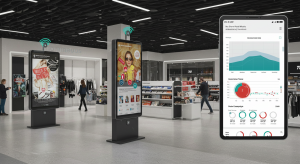
Retail media has become one of the fastest-growing advertising channels globally. As retailers expand their in-store retail media networks and CPG brands commit larger portions of their marketing budgets to in-store placements, digital signage, and shopper-facing advertising, measurement rigor has become non-negotiable. Three forces are driving this urgency.
1. Investment Scale Demands Accountability
Retail media campaigns now compete directly with digital, social, and traditional media for budget allocation. Teams across brand, shopper marketing, and trade must demonstrate that retail media investments generate measurable business outcomes—not just impressions delivered. Merely serving an ad doesn’t guarantee it was seen, a distinction central to the IAB’s retail media measurement framework.
The IAB now advises against counting impressions based on scheduling alone. Instead, Retail Media Networks (RMNs) must adopt verified impression metrics that reflect actual consumer exposure. Without reliable retail media measurement, teams cannot make the case for continued or increased spend.
2. Physical Stores Remain Difficult to Measure
Unlike digital advertising, physical retail environments have historically lacked the infrastructure to track how shoppers interact with campaigns in real time. Traditional retail media reporting focuses on media delivery like impressions served, and estimated reach, but these metrics do not capture whether shoppers actually engaged with a placement or were influenced to consider a product.
3. Behavioral Data Is the Competitive Edge
Brands that go beyond surface metrics and measure actual in-store shopper behavior gain a compounding advantage: each campaign generates insights that inform and improve the next. Brands without this capability are flying blind in one of their highest-investment media channels.
How CPG Brands Measure Retail Media Campaign Performance
The most effective retail media measurement programs use a layered approach that captures the full shopper journey, from first exposure to product interaction. Here is how each layer works.
Campaign Exposure and Reach
Understanding how many shoppers were exposed to a campaign is the foundation of retail media performance measurement. Verified reach provides a baseline visibility metric comparable to impression counts in digital advertising. However, exposure alone does not indicate whether a campaign successfully influenced shopper behavior.
Shopper Engagement with In-Store Media
Engagement metrics reveal how shoppers actually interact with campaign placements, not just whether they walked past them. The most important retail media performance metrics at this layer include:
- Dwell time: How long shoppers remain within the impact zone of a display, which correlates with brand recall and consideration.
- Traffic diversion: Whether a placement successfully drove shopper flow toward a target aisle or promotional zone.
- Engagement rate: The percentage of exposed shoppers who paused, approached, or interacted with the promotional area.
These engagement signals help brands determine whether creative executions are capturing shopper attention or being ignored, and identify the store’s busiest areas at various points throughout the day
Product Interaction and Purchase Influence
 The next layer connects campaign exposure to product consideration. Did shoppers who engaged with a display subsequently move to the category shelf? Did campaign placements increase visits to a promoted product area? Understanding these behavioral patterns provides a far more complete picture of retail media campaign performance than sales lift alone, and continuously testing and improving curated messages allows stores to optimize in-store marketing
Cross-Campaign and Cross-Retailer Benchmarking
Most CPG brands run campaigns simultaneously across multiple retail media networks and store formats. Standardized retail media analytics allow brands to compare performance across retailers, regions, store clusters, and campaign types—identifying which strategies generate the strongest ROAS and where to reallocate investment. The brands achieving the highest retail media ROI are those measuring performance at every layer, not just the impression at the start and the sale at the end.
What Data CPG Brands Need from Retail Media Networks
Meaningful retail media measurement requires access to data that most retailer-provided reports do not currently include. Beyond campaign delivery summaries, CPG brands need:
- Shopper behavior analytics: Granular data on how shoppers move through the store, which areas they visit, and where they spend the most time particularly around campaign placements.
- Audience segmentation insights: Behavioral data identifying which shopper segments (frequent category buyers, new-to-brand visitors, high-intent shoppers) respond most effectively to specific in-store media formats.
- Campaign attribution data: The ability to connect a media exposure event to downstream shopper behavior and product interaction. This is the most valuable, and most frequently missing, data point in retail media reporting.
- Real-time campaign visibility: Access to performance data during a campaign flight, enabling optimization before it ends rather than post-mortem analysis only.
Brands are increasingly including measurement and attribution data requirements, not just reach guarantees, in their retail media network contracts. Retailers that provide this visibility will win those media budgets.
In-Store Attribution: The Missing Link in Retail Media Measurement
Attribution is where most retail media measurement programs fall short. Standard reporting captures the bookends of the shopper journey, the impression and the transaction, but misses everything in between. In-store retail media attribution fills that gap.
What Traditional Reporting Misses
Impression and reach metrics confirm that a campaign was delivered. They do not explain whether shoppers noticed the placement, whether it changed their navigation behavior, or whether it influenced their product selection. Ignoring movement turns attribution into guesswork. It inflates exposure estimates and masks underperforming placements. Without behavioral attribution, brands cannot answer the questions that matter most for optimization.
 What Attribution Analytics Reveal
Retail media attribution connects media exposure to real shopper activity. With attribution data, brands can understand:
-
- Whether shoppers who saw a placement spent more time in the promoted category
- Which creative variants drove higher engagement-to-purchase conversion
- Whether endcap exposure influenced adjacent SKU lift, not just the featured product
- How performance varied across store formats, shopper demographics, or time of day
Why Attribution Enables Optimization
When brands can measure how shoppers respond to retail media campaigns in real time, they can adjust creative, modify placement strategy, or shift investment to better-performing store clusters mid-flight, and strengthen loyalty with relevant, useful content. Without attribution, optimization is based on estimates. With it, it is based on evidence.
Connecting In-Store Analytics to Retail Media ROI
In-store analytics platforms function as the physical-world equivalent of digital tracking infrastructure. They instrument the store environment to capture the behavioral signals that make meaningful retail media measurement possible.
For CPG brands evaluating retail media performance, these platforms provide:
-
- Real-time traffic flow data: Shopper movement patterns across the store, updated continuously rather than aggregated after campaign completion.
- Verified dwell and engagement metrics: Confirmed shopper presence and engagement duration within defined campaign zones—not modeled estimates.
- Behavioral audience segmentation: Clustering of shopper types based on in-store behavior to identify which segments respond to which media formats.
- Full-funnel exposure analysis: Data connecting a media exposure event to subsequent navigation and category interaction, enabling end-to-end attribution.
Walkbase delivers this measurement layer for retail media campaigns. By combining in-store audience analytics with campaign data, Walkbase gives CPG brands the evidence needed to validate investments, optimize performance mid-campaign, and build the internal business case for continued retail media scaling, all without using cameras or sacrificing shopper privacy.
Conclusion
Retail media has become a critical component of the CPG marketing mix. As investment in in-store retail media networks continues to grow, brands are rightly demanding greater transparency, richer attribution, and more accountable campaign reporting from their retail partners in those physical spaces
Measuring in-store RMN performance effectively means moving beyond impressions and reach. Understanding shopper engagement, in-store behavioral patterns, and the connection between campaign exposure and product interaction is now essential to evaluating campaign impact and optimizing future spend.
Retailers and technology providers that deliver this depth of measurement will earn the trust, and the budgets, of the CPG brands that take retail media seriously.
Get Started
Walkbase provides retailers and advertisers with the tools to directly connect retail media investments to shopper outcomes, without sacrificing customer privacy or using cameras. Explore our in-store retail media measurement solutions today.