

In-store retail media has moved from experimentation to serious investment, with brands increasingly allocating budget to physical stores as high-impact media environments. Yet as brand spend has grown, so has scrutiny. One of the biggest barriers to retail media network (RMN) maturity has been inconsistent retail media measurement, especially inside physical locations where standards have historically lagged digital channels.
Measurement Is the Missing Link in RMN Maturity
In December 2025, the IAB addressed the in-store measurement challenge with A Viable Framework for Maturing In-Store Media Measurement, offering practical guidance for in-store retail media measurement that retailers and RMNs can act on today. Rather than a theoretical model, the framework establishes clear expectations around verification, context, and privacy. Below are the key takeaways and what they mean for long-term RMN growth.
Verified Impressions Are Now the Industry Baseline
 Playing an ad is not the same as proving exposure. That distinction sits at the core of the IAB retail media measurement framework. According to IAB guidance, impressions should no longer be counted simply because content was scheduled or displayed. Instead, RMNs must move toward verified impressions grounded in real-world conditions.
The framework defines a verified impression using three foundational elements — often referred to as the “Three Ps”:
- Play: The ad was actually rendered on the screen as planned.
- Presence: Shoppers were present near the screen during playback.
- Pairing: Shopper presence was time-aligned with ad play.
This approach sets a new floor for RMN measurement standards. Verified impressions provide advertisers with confidence that exposure truly occurred, reducing ambiguity and inflated counts associated with unverified metrics.
Just as importantly, verified impressions enable comparability across networks. When in-store RMNs adopt consistent definitions and transparent methodologies, brands can evaluate performance across locations and partners with far greater confidence — an essential step for scaling in-store media investment.
Presence Measurement Must Move Beyond Assumptions
Historically, in-store media relied heavily on opportunity-to-see (OTS) models, often based on store traffic averages or assumed dwell times. While the IAB acknowledges this as an acceptable starting point, the framework makes it clear that assumptions alone are no longer sufficient for long-term credibility.
The preferred future state emphasizes more precise indicators of presence, including:
- Proximity to the screen
- Directionality or field-of-view signals
- Time-aligned pairing with ad playback
Crucially, the IAB explicitly clarifies what is not required to achieve this level of accuracy. The framework states that presence measurement does not require facial recognition or biometric identification. This guidance reinforces the importance of privacy-safe in-store measurement approaches that avoid collecting personal data altogether.
By prioritizing sensor-based signals over identity-based tracking, the IAB positions privacy-safe measurement as both a technical and strategic advantage; one that supports scalability without introducing unnecessary regulatory or reputational risk.
Store Zones Provide Critical Context for Measurement
Another key insight from the IAB retail media measurement framework is that context matters as much as exposure itself. The framework introduces the concept of store zones of influence, recognizing that shopper behavior — and media impact — varies significantly by location within the store.
Key zones outlined by IAB include:
- Entry
- Aisle
- Checkout
- Perimeter
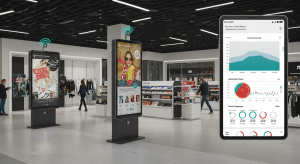 Zone-level measurement allows in-store RMNs to better understand where exposure occurs, not just that it occurs. This contextual layer improves campaign optimization, supports more accurate media valuation, and enhances retailer-to-retailer comparability.
Sensor-based in-store measurement allows retailers and brands to clearly understand if a campaign generates better lift in one zone than another. Now stores can use data to prove that a specific ad performs best in the aisle instead of at the checkout kiosk.
By aligning in-store media metrics with real shopper movement and behavior, RMNs can offer brands insights that go beyond surface-level impressions — insights that reflect how physical environments actually function as media channels.
Dwell Time, Reach, and Frequency Anchor the Insights Layer
One of the most important signals of RMN maturity is alignment with the planning language used across digital and out-of-home channels. The IAB framework addresses this through an Insights Layer built on familiar performance metrics.
Key metrics highlighted include:
- Unique reach
- Frequency
- Dwell time
Among these, dwell time plays a particularly critical role in how in-store retail media is measured. Unlike raw impression counts, dwell time helps quantify the quality of exposure — how long shoppers remained within view of a screen while an ad was playing.
By combining dwell time with reach and frequency, in-store RMNs can deliver a more nuanced view of performance that resonates with brand buyers. This interoperability positions in-store media as a measurable, accountable channel rather than a black box.
Privacy-by-Design Is Non-Negotiable
Measurement credibility ultimately depends on consumer trust. That is why privacy is not treated as an optional enhancement within the IAB framework, but as a foundational requirement.
The IAB’s guidance emphasizes:
- Data anonymization and minimization
- No collection of raw personally identifiable information (PII)
- Transparent disclosure of measurement methodologies
 Camera-based and biometric-heavy approaches may introduce future risk as privacy regulations evolve and consumer expectations rise. In contrast, privacy-safe, camera-less measurement methods align directly with IAB principles by delivering verified insights without collecting personal data.
This privacy-by-design approach supports regulatory readiness, strengthens brand confidence, and ensures that RMNs can scale measurement capabilities without compromising trust.
What the IAB Framework Signals for 2026 and Beyond
The IAB retail media measurement framework sends a clear signal to the industry: assumptions are no longer enough. Verified impressions must replace raw counts, context and dwell must outweigh volume alone, and privacy must be built into measurement from the start.
For retailers attempting to monetize in-store RMNs, aligning with these principles is no longer about future-proofing — it is about meeting the minimum standard for credibility today. Networks that adopt privacy-safe, camera-less approaches grounded in IAB guidance will be best positioned to scale retail media measurement with trust, transparency, and accountability well into 2026 and beyond.
Let the team at Walkbase help you build privacy-safe solutions for measuring the performance of your in-store retail media network. Contact us today.