

In-store retail media is not inherently broken. Screens work. Brands want physical-world reach. Retailers want new revenue streams tied to their stores. Yet many in-store retail media programs underperform, stall at pilot stage, or lose brand confidence over time.
The issue isn’t screen quality, network scale, or content strategy. The root cause is more fundamental: most programs are built without a real understanding of shopper behavior.
Brands want proof. Retailers want trust — from advertisers, shoppers, and regulators. But too many retail media networks skip the hard work of measurement and jump straight to monetization. When programs lack visibility into footfall, dwell time, and movement, media performance becomes assumed rather than proven.
Measurement is not a reporting add-on. It is the foundation. When it’s missing, everything built on top of it is unstable.

Mistake #1: Treating Screens as Impressions
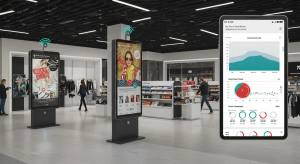 One of the most common retail media mistakes is equating screen presence with media value.
A screen in a store is not an impression. A powered-on display does not guarantee attention. Counting screens, loops, or play-outs tells you nothing about whether shoppers were present, facing the display, or moving slow enough to notice it.
This is where in-store advertising effectiveness often breaks down. Exposure is not the same as engagement. Opportunity-to-see, as defined by the IAB, depends on real human behavior, not hardware inventory.
Brands are increasingly questioning in-store metrics because many programs still rely on assumptions instead of evidence. When impression counts are derived from static formulas rather than observed shopper behavior, confidence erodes quickly.
Retail media measurement must start with people, not pixels.
Mistake #2: Ignoring Footfall and Dwell
Ads cannot perform if no one is there.
Footfall is the most basic input for any in-store retail media program, yet it is frequently overlooked or treated as a background stat. Store traffic fluctuates by hour, day, season, promotion, and even weather. Static averages hide this variability and distort reporting.
Dwell time adds critical context. It is a practical proxy for opportunity-to-see — how long shoppers remain within a zone where a screen is visible. Without dwell, exposure is speculative at best.
Footfall and dwell time for retail media answer two essential questions:
- Who was present?
- For how long?
If a program cannot answer those questions at a zone level, it cannot credibly claim performance.
Mistake #3: Measuring Media Without Understanding Movement
Pass-Through vs. Intentional Exposure
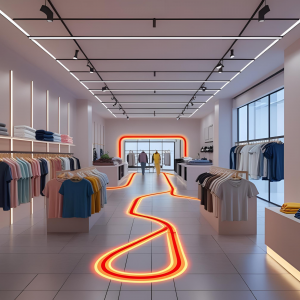 Not all traffic is equal.
A shopper walking quickly through an aisle is not the same as one slowing down, browsing, or waiting. Directional movement matters. Speed matters. Pathing matters.
Ignoring movement turns attribution into guesswork. It inflates exposure estimates and masks underperforming placements. Shopper attention insights in physical retail require understanding how people actually move through space, not just where screens are installed.
Zone Blindness Inside Stores
Many programs treat stores as uniform environments. They are not.
Some zones naturally generate higher dwell and attention. Others are pass-through areas with minimal opportunity-to-see. Without zone-level analytics, retailers price and place media blindly.
Zone blindness leads to dead zones being sold as premium inventory and high-value zones being undervalued. This hurts both performance and trust.
Mistake #4: Relying on Camera-Based or Intrusive Measurement
As brands push for proof, some programs turn to camera-based measurement or biometric shortcuts. This is a short-term fix with long-term consequences.
Cameras introduce privacy risk, regulatory exposure, and shopper discomfort. Even when anonymized, they raise questions about consent and surveillance that many retailers would rather avoid.
Shopper trust is fragile. Once eroded, it is difficult to regain. Retail media networks that depend on intrusive methods may win early pilots but struggle to scale sustainably.
Proving in-store ad effectiveness without cameras is not only possible — it is necessary for long-term viability. Privacy-safe, sensor-based analytics provide behavioral insight without collecting biometric data or identifying shoppers.
What Actually Works: Shopper Attention Analytics
Effective in-store retail media programs are built on shopper attention analytics, not assumptions.
- Footfall establishes reach.
- Dwell provides context and opportunity-to-see.
- Movement validates exposure and quality.
Together, these metrics support credible reach, frequency, and exposure calculations grounded in observed behavior. They replace guesswork with evidence.
This is how measurement-first programs create metrics brands can trust and retailers can defend.
How to Measure In-Store Retail Media Performance — Correctly
 Correct measurement aligns with emerging IAB-style retail media frameworks while respecting the realities of physical space.
That means:
- Measuring exposure at the zone level, not the store average
- Connecting media delivery to real traffic patterns
- Reporting variability, not smoothing it away
- Supporting attribution without identifying shoppers
Retail media measurement should explain why performance changes, not just what happened. When analytics reflect actual shopper behavior, performance conversations become clearer, faster, and more credible.
This approach also strengthens internal alignment. Operations, media, and analytics teams can work from the same behavioral truth instead of competing assumptions.
Why Measurement Is the Difference Between Pilot and Scale
Most in-store retail media programs do not fail outright. They stall.
Brands hesitate to expand budgets when performance cannot be validated. Retailers hesitate to scale networks they cannot clearly explain or defend.
Measurement is the bridge between pilot and scale.
Analytics connect operational reality with media ambition. They enable proof, transparency, and trust — without compromising privacy. Programs built on behavioral intelligence last longer because they are easier to justify, optimize, and govern.
Measurement-first retail media networks scale responsibly because they are grounded in how stores actually work.
Retail Media Doesn’t Fail — Measurement Does
In-store retail media succeeds when it is built on shopper behavior.
Footfall, dwell, and movement are not optional metrics. They are the foundation of credible performance. Without them, even the most sophisticated screens and content strategies will underdeliver.
Privacy-safe analytics protect both revenue and reputation. They allow retailers to prove value to brands while maintaining shopper trust and regulatory confidence.
Walkbase enables in-store retail media programs that perform, scale, and endure by providing the behavioral intelligence layer most programs overlook. When retail media measurement comes first, in-store media finally works the way it was intended to.