
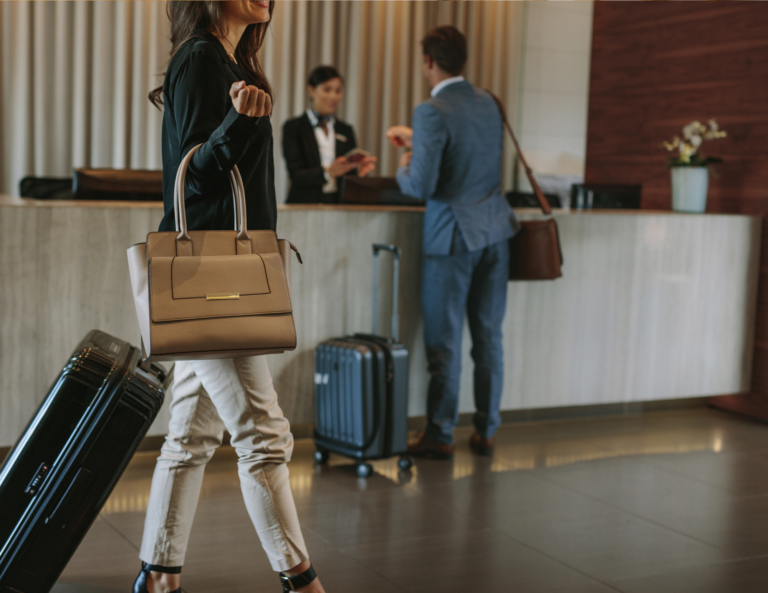
Why the Lobby Is the Hotel’s Most Fragile Moment
The hotel lobby is a high-stakes operational node where a guest’s perception of your brand is cemented in the first five minutes. While marketing teams spend months perfecting digital first impressions, the real brand experience is won or lost the moment a guest walks through the door.
In high-volume hotels, arrival waves often collide with limited desk capacity. The resulting congestion is more than an inconvenience; it’s a friction point that devalues premium branding and exhausts front-line staff. Traditionally, these bottlenecks were treated as unavoidable “crushes” — but they are actually solvable data gaps.
With guest flow analytics (also called lobby flow analytics), congestion is no longer a mystery to be managed by intuition. Precision data allows operators to move past reactive firefighting and begin designing arrival experiences that are as efficient as they are welcoming.
The Real Cost of Lobby Congestion
 Lobby congestion is frequently dismissed as a temporary inconvenience, but for Operations Directors and General Managers, the costs are deep and measurable.
- Service Quality Erosion: Long wait times are the primary driver of negative guest sentiment. A 15-minute wait at check-in doesn’t just delay the guest; it colors their entire perception of value for the remainder of their stay.
- Front-Desk Burnout: When staff are constantly facing a sea of frustrated faces, turnover increases. Operational friction at the desk leads to “transactional” service rather than “hospitality” service.
- Missed Upsell Opportunities: A congested lobby is a rushed lobby. When a front desk agent is trying to clear a queue of twenty people, they are significantly less likely to suggest a room upgrade, a spa package, or a dinner reservation.
- The “Throw People at It” Fallacy: The default response to congestion is often to add more staff. However, without data, this is an expensive guess. If the bottleneck isn’t staffing levels but rather lobby layout or kiosk placement, adding more labor simply increases overhead without solving the root cause of the delay.
What Guest Flow Analytics Reveals in Hotel Lobbies
To fix the flow, you must first see the flow. Lobby flow analytics provides a granular look at how guests move through your space, stripping away the guesswork.
Hospitality Footfall Patterns by Time and Day
Operational efficiency starts with understanding the “Arrival Curve.” Most hotels know their occupancy numbers, but they often lack visibility into the specific arrival waves. Analytics reveals whether your 3:00 PM peak is a steady stream or a sharp spike that occurs at 3:12 PM when the airport shuttle arrives. Understanding these patterns — from weekday corporate travel to weekend leisure groups — allows for surgical staffing adjustments.
Check-In Wait Time Analysis Beyond the Front Desk
A “wait time” isn’t just the time spent talking to an agent. From an operational perspective, the clock starts the moment a guest joins the queue. Check-in wait time analysis measures the entire duration of the “waiting” experience. By distinguishing between dwell time in line and dwell time in lobby zones (like the bar or lounge), operators can identify if guests are stuck or if they are lingering by choice.
Lobby Congestion Insights Across Zones
A lobby is a multi-functional space. Congestion often occurs because of “flow conflicts” — where departing guests trying to find the elevators collide with arriving guests trying to find the concierge. By analyzing zone-level data, hotels can see exactly where these “traffic jams” occur. Is the self-service kiosk being ignored because it’s placed in a high-traffic “pass-through” zone? Analytics provides the answer.
Improving Hotel Operational Flow with Data, Not Guesswork
The transition from “managing” a lobby to “optimizing” a lobby requires a shift toward data-driven decision-making. Hotel operational flow is a science that balances guest demand with facility capacity.
- Aligning Staffing to Real Demand: Instead of staffing based on historical check-in averages, GMs can staff based on real-time and predictive footfall patterns. This ensures the right number of “keys in hand” during the 4:00 PM rush while reducing labor waste during lulls.
- Repositioning Physical Assets: If the data shows that 40% of guests bypass the main desk to ask the concierge for directions, it’s a sign that your signage or lobby layout is failing. Flow analytics allows you to reposition kiosks, desks, and wayfinding to create the path of least resistance.
- Supporting Staggered Arrivals: By understanding when peaks occur, hotels can proactively communicate with guests — perhaps offering a “quiet hour” check-in incentive or directing early arrivals to the lobby bar to disperse the crowd.
From Insight to Action: Reducing Wait Times in Practice
How does this look on the ground? It starts with the creation of repeatable operational playbooks.
When a hotel identifies a recurring congestion window via lobby congestion insights, they can test interventions. For example, if a resort sees a massive spike in wait times every Friday at 2:00 PM, they might implement a “mobile check-in” zone in the center of the lobby. Using Walkbase, the operations team can then measure the success of that change: Did the average queue time drop? Did the “dwell” in the bar increase as a result of a faster check-in?
By validating improvements with hard metrics, GMs can prove the ROI of operational changes to ownership and corporate leadership.
Why Guest Flow Analytics Must Be Privacy-Safe
In the hospitality world, guest trust is everything. As hotels adopt more technology, the concern over privacy and surveillance grows. This is why Walkbase prioritizes a privacy-safe, sensor-based approach.
Unlike camera-based systems that utilize facial recognition, Walkbase utilizes anonymous sensor data. This provides high-fidelity insights into movement, queues, and density without ever identifying an individual guest. This approach ensures:
- Guest Comfort: No “Big Brother” feeling in what should be a relaxing environment.
- Operational Focus: The goal is to measure the flow, not the person.
How Walkbase Enables Smarter Lobby Decisions
 Walkbase serves as the measurement and insight layer for the modern hotel. We don’t just provide a dashboard; we provide the operational clarity needed to run a complex property.
- Sensor-Based Precision: Our technology measures footfall, dwell times, and queue lengths across complex, multi-zone environments with high accuracy.
- Holistic Visibility: From the porte-cochère to the elevator banks, see the entire journey in one view.
- Scalable Architecture: Whether you are managing a boutique property or a global portfolio of resorts, Walkbase scales to provide consistent operational KPIs across all locations.
- Integration Ready: Walkbase works alongside your existing tech stack, providing the “movement layer” that complements your PMS and labor management systems.
Faster Flow, Better First Impressions
Lobby performance is no longer a “soft” metric. In a competitive hospitality landscape, the ability to move guests through your lobby efficiently is a direct driver of operational profitability and guest loyalty.
Reducing wait times starts with understanding movement. When you stop guessing where the bottlenecks are and start measuring them, you gain the power to turn a chaotic arrival into a controlled, confident operation. Guest flow analytics gives you the clarity to ensure that your hotel’s most fragile moment becomes its strongest asset. Get started with Walkbase today.