

Retailers often use the terms foot traffic and footfall analytics as if they mean the same thing.
They don’t.
And in today’s data-driven store environments, that distinction matters more than ever. Traffic data influences staffing models, lease negotiations, marketing investment, conversion benchmarking, and expansion planning. For retail operations leaders and analytics directors, it’s not just a reporting metric; it’s an input into capital allocation and performance strategy.
Yet many organizations still rely on basic people-counting systems, assuming that visitor volume alone explains store performance.
It doesn’t.
If you’re comparing vendors or evaluating your current retail traffic measurement approach, understanding the difference between foot traffic analytics and footfall analytics is critical.
Why Retailers Are Searching for Traffic Clarity
Retail leaders today are trying to do more with their stores. They’re focused on improving conversion rates, aligning labor with real demand, benchmarking performance across regions, and proving the ROI of in-store investments.
But terminology confusion creates friction.
When “people counting retail” is presented as equivalent to behavioral insight, expectations get misaligned. A store team may believe they’re investing in optimization tools when they’re actually purchasing basic counting hardware. That disconnect leads to underpowered analytics and, ultimately, disappointing outcomes.
Clarifying definitions isn’t academic. It protects better decision-making.
What Is Foot Traffic?
Foot traffic refers to the number of people entering a store or crossing a defined sensor. It’s a volume metric — straightforward and useful at a high level.
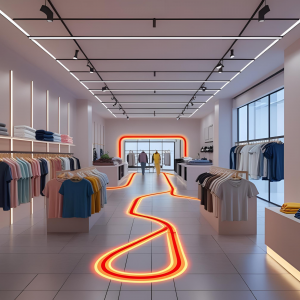
Most traditional foot traffic analytics setups rely on infrared beams, thermal sensors, or simple overhead camera counters positioned at entrances. These systems track entries and exits, providing a daily or hourly count of visitors.
That data has value. It helps retailers identify macro trends, compare performance by week, and assess general store popularity. For top-line visibility, it works.
But it stops there.
Foot traffic answers one question: How many people came in?
It doesn’t explain what those people did once they entered. There’s no dwell analysis, no understanding of pathing, no zone engagement, and no insight into how behavior connects to conversion.
In short, it’s counting, not analyzing.
What Is Footfall Analytics?
Footfall analytics builds on traffic measurement but goes much further.
It still captures entry volume, but it also analyzes how shoppers behave inside the store. That includes dwell time, movement paths, zone engagement, repeat visitation patterns, and correlation with point-of-sale data.
Instead of just reporting that 2,000 people entered, footfall analytics can reveal how long they stayed, which departments they engaged with, where congestion occurred, and how those behaviors aligned with purchases.
This is where retail traffic analysis software becomes strategic.
Footfall analytics connects in-store traffic data to operational performance. It allows teams to investigate why two stores with similar traffic levels may have dramatically different conversion rates. It provides the context that volume metrics alone cannot deliver.
How Is Foot Traffic Measured in Retail?
A common high-intent question retailers ask is: How is foot traffic measured in retail stores?
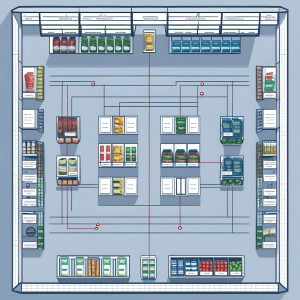 The answer depends on the level of sophistication.
Basic people counting systems typically use infrared beams that register when a beam is interrupted. Thermal sensors detect heat signatures, and simple camera-based counters use video to estimate entries. These approaches are relatively affordable and easy to deploy, but they are primarily designed for counting.
Advanced analytics platforms take a different approach. Using computer vision and AI-based tracking, they anonymously analyze movement patterns throughout the store. These systems can distinguish between staff and shoppers, measure zone-level engagement, and track behavioral patterns over time.
Accuracy varies across technologies. Environmental factors such as lighting, entrance configuration, mounting height, and calibration practices all affect results. Retailers typically ask, “How accurate are retail people counters?” The more important follow-up question is: What is the objective of that accuracy?
A system that delivers high entry-count accuracy may still lack the behavioral precision required for conversion rate optimization or marketing attribution.
Why People Counting Alone Is No Longer Enough
People counting tells you how many entered your business.
Footfall analytics tells you what happened next.
For operators responsible for revenue and cost control, that difference is significant. Conversion rate analysis requires reliable traffic alignment with POS data. Labor optimization depends on understanding peak demand windows and queue formation. Store layout improvements require insight into dwell time and zone engagement.
If traffic increases but conversion declines, is the issue staffing, merchandising, pricing, or layout? Volume alone cannot answer that. Behavioral context can.
As retail environments grow more complex — particularly with the rise of in-store retail media — the need to correlate exposure with purchase becomes even more critical. People counting systems retail teams relied on years ago were not built for attribution modeling. Today’s environment demands it.
The Operational Benefits of Footfall Analytics
When implemented effectively, footfall analytics supports multiple operational priorities.
1. Conversion Rate Precision
By aligning in-store traffic data with transaction data, retailers can calculate true conversion rates by store, department, or campaign. That clarity supports performance benchmarking and more informed decision-making.
2. Labor Optimization 
Instead of staffing based on historical schedules alone, retailers can align coverage with real demand patterns. Understanding when and where congestion forms allows managers to reduce wait times and protect sales.
3. Layout & Merchandising Intelligence
Zone-level engagement data highlights dead space, high-performing displays, and underutilized areas. That insight informs capital investments and store redesign strategies.
4. Marketing Attribution
As in-store media networks grow, brands increasingly demand proof of exposure and impact. Footfall analytics makes it possible to correlate campaign exposure with purchase behavior — transforming store traffic analytics into a revenue-enabling capability.
Foot Traffic vs Footfall Analytics: Which Should Retailers Invest In?
The right choice depends on your objectives.
If your goal is basic trend monitoring or high-level traffic comparison, a simple people-counting system may meet your needs.
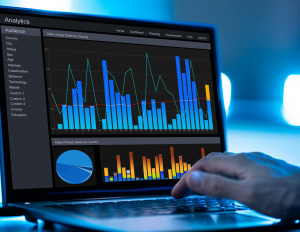 But if you are focused on conversion rate optimization, revenue impact, labor efficiency, or performance benchmarking across a portfolio, basic counting is unlikely to be sufficient.
Retail analytics maturity typically follows a progression: counting, then measuring, then optimizing. Many organizations remain at the counting stage while expecting optimization outcomes.
Technology investments should align with strategic ambition.
The Evolution from Counting to Attribution
Retail performance measurement is evolving quickly. Store leaders increasingly require cross-store comparability, real-time dashboards, and integration with POS and marketing data. They want scalable analytics that can support both operational execution and strategic growth.
Footfall analytics is becoming foundational not only to store performance benchmarking, but also to retail media measurement and in-store campaign validation.
Platforms like Walkbase are designed to bridge this gap — not merely to count traffic, but to translate movement patterns into actionable operational insight. The objective is no longer simply to report volume. It is to connect behavior to measurable outcomes.
The question is shifting from “How many people entered?” to “How did store behavior impact revenue?”
Conclusion
Foot traffic and footfall analytics are often treated as interchangeable terms.
They are not.
Counting visitors establishes a baseline. Understanding behavior drives performance.
Retailers that rely solely on volume metrics risk overlooking the insights that determine profitability — from conversion optimization and labor alignment to marketing effectiveness and capital planning.
As stores continue to evolve into data-driven environments, analytics must move beyond simple counts. The future of retail traffic measurement lies in connecting movement to performance.
Retailers that make this shift will move from observing traffic to optimizing it.